
Ascension blog

Christ has no body but yours This coming Sunday is “God’s Work, Our Hands” Sunday at Ascension. Our hands will be put to work after worship to assemble packages for people served by local food pantries. Each kit delivered will be part of God’s work in the world. I’m not sure how leaders at the Evangelical Lutheran Church in America came to choose the phrase “God’s Work, Our Hands” for this annual day of community service. I’ve always suspected it was inspired by a poem by Teresa of Avila, a 16th-century Catholic nun who spent much of her life in prayer and contemplation. Her poem goes like this: Christ has no body but yours, No hands, no feet on earth but yours, Yours are the eyes with which he looks Compassion on this world, Yours are the feet with which he walks to do good, Yours are the hands with which he blesses all the world. Yours are the hands, yours are the feet, Yours are the eyes, you are his body. Christ has no body now but yours, No hands, no feet on earth but yours, Yours are the eyes with which he looks
compassion on this world. Christ has no body now on earth but yours. This poem certainly captures the spirit of “God’s Work, Our Hands” as it invites us to serve as Christ’s hands, feet, and eyes. If we stop to think about it, however, it might seem a bit strange that a woman who spent her life inside a convent seeking a mystical union with God should write such an activist poem, exhorting us to put our faith into practice by doing Christ’s work. Part of the explanation is that the convent was not a haven from the world for Teresa. The convent offered plenty of opportunities to be of practical service. But as a person of prayer and contemplation, Teresa would have focused not so much on what we can do for Christ, but rather on what Christ is doing in us. Teresa would remind us that Christ is still working. Christ’s pleasure and desire is to work through flesh and blood; it is Christ’s nature to take flesh in the world, to be present with us here and now. Christ invites us to join him in the ways that he is already present in the world to heal, bless, and serve. See you in church, Pastor David

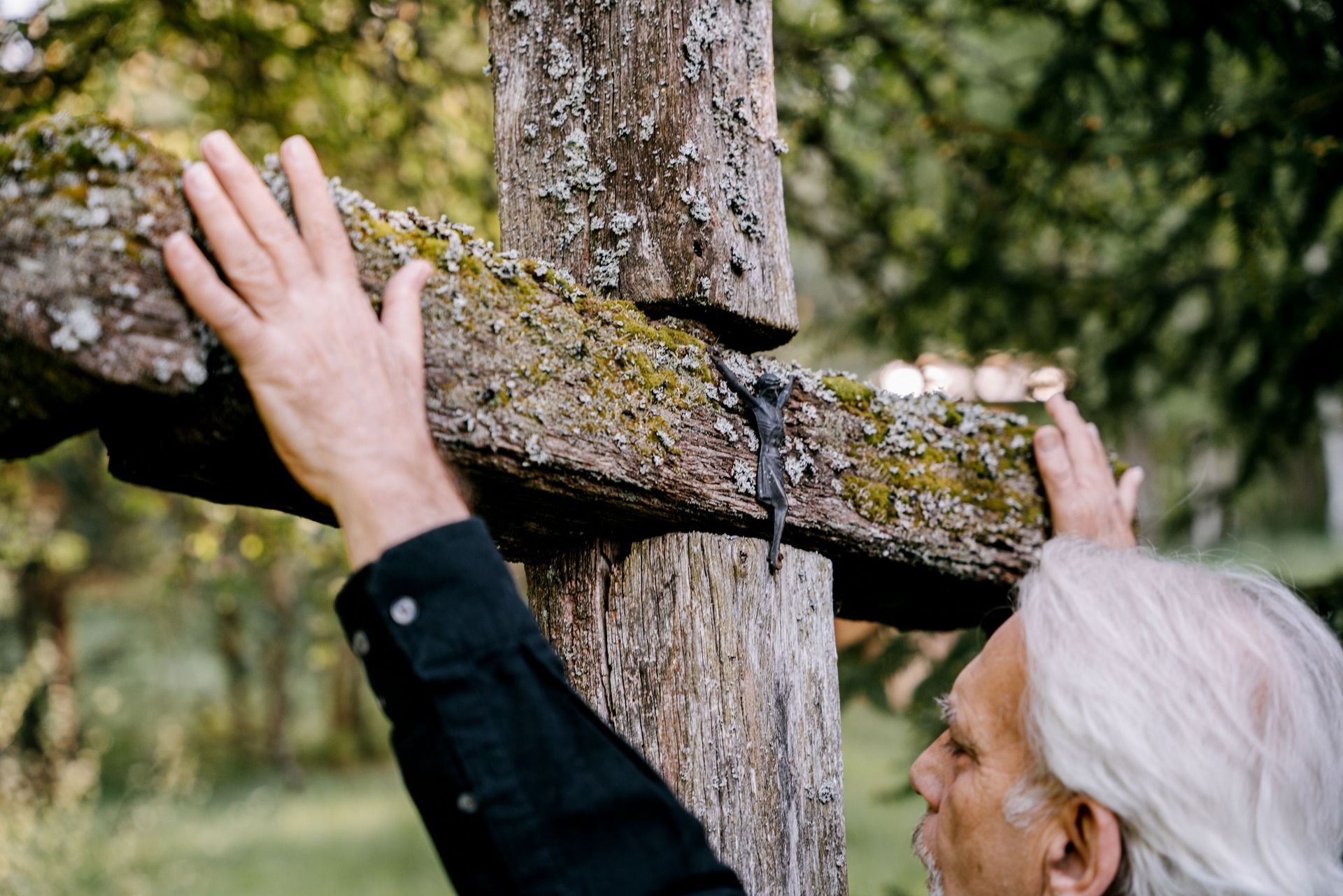
Jesus said, “If any want to become my followers, let them deny themselves and take up their cross and follow me.” The citizens of the Roman Empire were familiar with crosses. They were erected outside the cities of the Roman Empire for the execution of criminals and disobedient slaves. Crucifixion was the favored form of execution, because it was so excruciating and humiliating. The display of crosses made a point. The leaders of the empire were making sure everyone knew the terrible fate that awaited them if they disobeyed their masters or rebelled against the emperor. (I’m relying here on historian Tom Holland’s account in his 2019 book Dominion.) Crucifixion was not a topic that educated Romans liked to think about—which explains why, though this form of execution was widely used and accepted, there are few written accounts of it by writers of the ancient world. Among the accounts we have of crucifixion, four of them describe the execution of the same person. The victim was a wandering preacher from an obscure town north of Jerusalem; he was called Jesus of Nazareth. The four accounts of his crucifixion are found in the four Gospels. Those Gospel writers claimed that this crucified man was in truth God’s Son, and that after he was crucified, God raised him from the dead. No claim could have been more outrageous in the Roman world, or the Jewish world. People in the Roman Empire could easily imagine that great men like the emperor, Caesar Augustus, were divine. Caesar was often called a god or the Son of God. That made some sense because Caesar wielded godlike power over vast territory, and his career seemed a string of godlike triumphs. But that the son of God would be one of those unfortunate people humiliated and nailed to a cross—that seemed like a sick joke. As you came to church on this beautiful late summer day, I suspect that crucifixion was not what you were hoping to hear more about. And after all, we are a long way from Good Friday. But this little background helps us understand why Peter objects so strenuously when Jesus talks about taking up the cross. And when Jesus predicts that he will suffer and be killed in Jerusalem, it’s no wonder that Peter exclaims, “God forbid it! This must never happen to you.” He means: Not you, of all people. The messiah of God, crucified? God’s chosen one, crucified? What kind of sick joke is this? Peter was scandalized. And the scandal of the cross of Christ never quite goes away, no matter how many times we hear about it. But over the years, as Christians have pondered the passion of Christ, the meaning of the cross has seeped into people’s hearts and minds and created a new perception of how and where God may be at work. Even those who don’t think of themselves as Christians have been shaped by this Christian story. If God’s own Son was rejected and crucified, and then raised from the dead, then maybe the weak, the rejected, and the humiliated of the world are not despised by God, as was commonly thought. Maybe victims are innocent. Maybe they are people close to God’s heart. After the cross of Christ, we can never get it out of our heads that the powers of this world may get things terribly wrong. In God’s kingdom, Jesus said, the last will be first and the first will be last. And Jesus lives out this truth in his life. By his death and resurrection, Christ turns upside down our thinking about who are the winners and who are the losers. Jesus calls us to follow him in his upside-down life. He calls us to align ourselves with him and with all those who suffer rejection and humiliation. Jesus asks us to pick up a piece of his cross and bear some suffering or rejection for Jesus’ sake. Take up your cross, Jesus says. You don’t have to go looking for a cross to take up. Jesus himself does not go looking for a cross. But he accepted the cross when that was necessary to be faithful. You don’t have to go looking for a cross; the cross will find you—it will find you in the workplace, or in marriage, or in your family, or in your community. Or even at church. That story is at the heart of Claire Keegan’s recent book Small Things Like These. She tells the story of Bill Furlong, a man who delivers coal to his neighbors in a small town in Ireland. Bill is a hard worker, and he is devoted to his wife and five daughters. One of his regular customers is the local convent of Catholic sisters who run a program for unmarried mothers, most of them poor. The girls were seen as an embarrassment by their families and were quietly placed with the sisters. On his visits to the convent, Bill gets glimpses of how harshly these girls are treated; they are basically held prisoner, cut off from family and the outside world. Their babies are taken away from them—and where the babies are sent, the girls are never told. Thousands of Irish girls were in fact treated this way in a network of church-run programs known as the Magdalene Laundries. On one of Bill’s visits to the convent, he passes some girls scrubbing the floors. One girl grabs him and asks him to take her away. “At least take me as far as the river,” she says. “All I want to do is drown myself. Can’t you do even that much?” Bill moves past her, but he can’t get her words out of his mind. On his next delivery of coal to the convent, he opens the coal shed and discovers a young girl locked inside. She is barefoot and shivering from the December cold. He gives her his jacket and leads her to the convent and knocks on the door. They are greeted by the Mother Superior, who ushers Bill and the shivering girl inside and serves them tea. The Mother Superior acts kindly, but she shrewdly pressures the girl to say she must have been accidentally left behind in the coal shed after a game of hide-and-seek. Bill doesn’t buy that explanation, but he says nothing. As Bill prepares to leave, the Mother Superior hands him an envelope. It’s a generous Christmas bonus. Bill knows it is meant to ensure his silence about what he has seen. While he goes about his day, Bill can’t stop thinking about what is going in the convent. Bill’s wife and others in town tell him to mind his own business. Nothing good can come from opposing the convent, they tell him. The sisters have a lot of power, and they are backed by the forces of the church and the state and public opinion. Bill’s wife and friends remind him that the nuns can deny his daughters a place in the local Catholic school if he gets on their wrong side. But Bill is nagged by a question: What if those were his daughters? “Was there any point in being alive [he wonders] without helping one another? Was it possible to carry through all the years . . . without once being brave enough to go against [the powers of the world] and yet call yourself a Christian?” That evening he goes to the convent, opens the door of the coal shed, and discovers that the same girl has again been locked inside, barefoot and thinly dressed against the cold. He puts his coat around her and leads her outside, and this time they walk toward Bill’s home. He intends to make her part of his family, though he knows it won’t be easy. His wife and his neighbors won’t be happy about this. He knew the worst was ahead of him. But in another way the worst was behind him—for how much worse it would have been for him to have done nothing, and to have gained the world but lost his soul. As Bill walks with the girl toward home, Keegan writes, he felt a kind of lightness; he felt an “unrecognizable joy” and peace. He felt like the best part of himself was emerging. Jesus says that by giving our live away for the sake of the gospel we will find our lives. The cross of Christ is God’s gift to us, so that we can find in this troubled world a different kind of peace than the world gives. God promises to meet us at the crosses that find us, and to fill our lives with his presence—with grace and peace, and an unrecognizable joy. Today God is sending us the Holy Spirit to bring out the best part of ourselves, through Christ our Lord. Pentecost 14A August 30, 2026 Ascension Lutheran Church Matthew 16:21–28

I saw Christopher Nolan’s film version of The Odyssey— it’s three hours long, but the time goes by quickly! If you’ve never read Homer’s epic poem (as I hadn’t), the movie conveys some of the scope and power of this great story.. Matt Damon plays the main character, Odysseus, as a soulful warrior. As the story unfolds, Odysseus mourns the countless deaths he has caused in battle and regrets the duplicity of his famous military trick—hiding soldiers inside a wooden horse in order to defeat the Trojans and destroy the city of Troy. An ingenious and brave leader, Damon’s Odysseus also broods over the “law of Zeus,” which commands respect for all human beings, something Odysseus knows he has failed to do. As several commentators have pointed out, this version of Odysseus departs from Homer and the classical traditions of Greece and edges toward a Biblical vision. Nolan, the director, might well have felt he needed to make this revision so that modern viewers could identify with Odysseus. The ancient world would have had few of the scruples expressed by Odysseus in the film. Ancient Greek and Roman societies celebrated the warrior virtues—strength, valor, honor, and the glory of military triumph. They assumed that the strong dominate the weak, and that the weak serve the strong. As one ancient historian put it, “The strong do what they can and the weak suffer what they must.” That’s just how the world works. Leaders of the ancient world would have agreed with the presidential adviser who recently explained US policy to a CNN reporter: “We live in a world . . . that is governed by strength, that is governed by force, that is governed by power. These are the iron laws of the world since the beginning of time.” It took a revolution in morality for an alternative worldview to emerge. Living on the other side of that revolution, we tend to assume that the exercise of power must be judged by moral norms of justice. We seek to listen to the voice of victims and we regard compassion for those who suffer as the essence of morality. To the extent we share those views, it is because we are shaped by centuries of Christians preaching, teaching, and meditating on the Gospel stories, which turned the world upside down with teachings like “Love your enemies” and “The last will be first and the first will be last.” The beginnings of this revolution can be traced to this week’s Gospel reading, in which Jesus discloses that he, the very Son of God, will become one of the least in the world. He “must go to Jerusalem and undergo great suffering at the hands of the elders and chief priests and scribes and be killed and on the third day be raised.” God’s Son will himself become a victim of those in power before he is raised in glory. This was an outrageous idea to the ancient mind. The belief that the Son of God suffered for the truth, and that those in power can be massively wrong, has transformed the way the world thinks about what power is for, and whose side God might be on. See you in church, Pastor David


The word sacrifice is one of those words which doesn’t exactly gladden our hearts. Though we know it is necessary to make sacrifices in life, we don’t relish them. Perhaps, at best, s acrifice conjures up the realistic wisdom of “No pain, no gain.” Interestingly, the Hebrew word for sacrifice originally had the meaning of “draw near” and “be vulnerable.” Those associations begin to make sense if we consider that when, say, a parent willingly makes sacrifices for the sake of a child, or a person offers to do something for another, it’s a way of one person drawing near to the other person and sharing life with them. Sacrifice of this kind does make us vulnerable; it takes something out of us. This “drawing near” also makes sense if we think about Jesus Christ as God’s sacrifice for us. What is God doing in Jesus but drawing near to us in flesh and blood. God offers himself in Jesus so that we might share more deeply in God’s life. In this week’s Epistle, Paul urges Christians in Rome to respond to what God has done in Christ by “presenting your bodies as a living sacrifice, holy and acceptable to God, which is your spiritual worship” (Romans 12:1). A “living sacrifice” is not a detached spiritual exercise for which we hope to get credit on some heavenly balance sheet. Rather, as Paul describes, it’s turning all of life into a form of worship, responding to God’s mercy and grace by showing mercy and grace to others. Eugene Peterson, a Bible scholar who wrote a contemporary version of the Bible called The Message, defines a sacrifice as a “readiness to interrupt whatever we are doing and build an altar, bind whatever we happen to be carrying with us at the moment, place it on the altar, and see what God wills to do with it.” Sacrifice is a way of orienting everyday life. In that vein, Peterson in The Message rewrites Paul’s words to the Romans in verse 12:1 this way: “So here’s what I want you to do, God helping you: Take your everyday, ordinary life—your sleeping, eating, going-to-work, and walking-around life—and place it before God as an offering.” See you in church, Pastor David

THE nations of the world came to America this summer in the form of the World Cup soccer tournament. The national teams of 48 countries competed to see which nation is the best at the sport the rest of the world calls football. I’m only a casual soccer fan but even I could see that the soccer was brilliant. And I think I finally figured out what offsides is in soccer. What really go my attention happened outside the soccer field. It was the enthusiastic and warm welcome that many Americans gave to these foreign teams and their fans. In Lawrence, Kansas, for example, where the team from Algeria was headquartered, the University of Kansas band learned to play the Algerian national anthem. Citizens of Lawrence adopted the team as their own and distributed scarves with Algeria’s colors. The Algerian players were reportedly moved to tears by this welcome. The Algerian players responded by organizing soccer clinics for local youth. Back in Algeria, the government of that mostly Muslim country decided to create a sister city relationship with Kansas City. There were a lot of feel-good stories like this throughout the tournament. Which came as something of a surprise given the political mood of our country and our nation’s current relationship with the rest of the globe. As a soccer fan from Scotland put it, “We were expecting to be met by ICE agents, aggressive police, and the political climate we all see on the news, and that could not be further from the truth of what we've actually experienced.” These are small gestures of hospitality, to be sure, but significant, for they give us a glimpse of that day envisioned by the prophet Isaiah when people of all nations will gather on God’s holy mountain and find unity in praising God together and living in a way that is a blessing to one another. In our Gospel reading today, we see that vision of Isaiah lived out by Jesus, as he reaches across boundaries of language, culture, and religion to bring healing to the daughter of a Canaanite woman. But let’s face it, this story of Jesus meeting a Canaanite woman is not exactly a feel-good story. It turns out to be rather more complicated than that, as maybe encounters with differences usually are if we dig into them. Jesus is not all that warm and welcoming, at least not at first. He tells the woman that healing a foreigner is not at the top of his agenda. “I was sent only to the lost sheep of the house of Israel,” he says, and adds what sounds to our ears like an insult: “It’s not fair to give the food meant for the children to the dogs.” Amazingly, the woman is not put off by Jesus’ comment. She seems to accept the fact that she is not the primary target of Jesus’ ministry. Her faith is resilient, however. She still has faith that there is enough of God’s power and mercy in Jesus for him to heal her daughter. “Even the dogs eat the crumbs from their master’s table,” she says. We can’t help wishing that Jesus had healed this woman’s daughter straight away. We can’t help wishing he had been more sensitive. But before we send Jesus off to a workshop on diversity, equity, and inclusion, we might remember that Jesus often challenged people and was not always quick to solve their problems. Jesus tends to ask awkward questions and tell provocative stories; he assumes people can be resilient, for his intention is to lead people to a deeper relationship with God. In his conversation with the Canaanite woman, Jesus names the elephant in the room, that is, he names the awkward truth, which is that there is a real difference between the Canaanites and the people of Israel and it is not trivial. The awkward truth is that Jesus’ entire ministry grows out of a very specific tradition that we call Judaism. Jesus does not try to hide this fact or pretend that such differences don’t matter at all. Perhaps we can take a lesson here for our own encounters with people of a different culture, religion, or political worldview. Perhaps we can learn to be resilient. In our nation we live in a time of huge political differences. The differences are often the elephant in the room at family gatherings. One approach we can take is to avoid talking about these differences. But that is hard to do and doesn’t always feel genuine. Another approach is to try to argue the other person into adopting our point of view—but that hardly ever turns out well. Few of us are ever argued out of our positions. There is another approach, and maybe a more Jesus-like approach: we can use the occasion to deepen the relationship. We can acknowledge differences and be curious about how the other person came to have the convictions they do and why they care about certain issues. And we might describe how we have come to hold the positions we hold. The goal of such a conversation would be to reveal something of ourselves and learn about the other, and to name what we long for, and the healing we hope for. That might bring us closer and point us toward the God who is bigger than our differences. Such conversations call for resilience. And a hope in a God who is bigger than our differences. Before we send Jesus to the diversity workshop we might also reflect on where we find ourselves in this story. Are we one of the disciples advising Jesus on how to conduct his ministry? Or are we closer to the Canaanite woman, desperate for healing, and knowing perfectly well that in a world of so much suffering we have no particular claim on God’s healing power, but we trust there is enough mercy and grace in Jesus Christ for us. A crumb from the table is all we need. That is what faith looks like, according to Jesus. And when we trust that there is enough of God’s healing and mercy for us, we are able to believe there is healing and mercy for those who are different from us. Some years ago, a Catholic priest named Gregory Boyle was assigned to a neighborhood of Los Angeles ravaged by gang violence. The world of gangs was vastly different from anything he had known. Part of him wanted to preach to these young men and women about the bad choices they were making. Part of him wanted to argue with them and convince them that they were headed toward either prison or a violent end. But after a while he realized that these men and women who belonged to gangs knew those facts better than anyone else. They knew that their lives were headed nowhere good. They knew they had no claim on God; in fact they were pretty sure God had no blessings for them. What they needed, Father Boyle decided, was a sign that there were crumbs of God’s mercy and grace left over for them. Father Boyle went on to create an organization called Homeboy Industries which offers jobs, job training, and counseling to former gang members. Boyle wanted to make God’s mercy tangible. And through these signs of God’s love, faith and hope have been awakened in these men and women. Which leads to their healing. Boyle tells the story of a man named Andre, who had been abandoned by his mother when he was 9 and was homeless for two years and survived on food that he scavenged from dumpsters. Eventually he ended up a gang and then in prison. Finally, coming out of prison, he made it to Homeboy Industries. One Monday morning, Andre had an appointment with his job counselor. The counselor knew Andre was always hungry and that he liked Triscuits, so she brought him a box of Triscuits. “You bought these Triscuits for me?” Andre asked in disbelief. The counselor nodded Yes. “You mean, you thought about me over the weekend?” Andre asked. The counselor said, “Yeah, I thought about you.” “You mean, you think about me when I’m not with you?” Andre said. “Wow. I never imagined anybody would think about me when I’m not with them.” Andre was learning to see himself as someone worth thinking about. He was beginning to trust that there was enough of God’s love and mercy also for him. Through Jesus Christ, God is making a new world out of a world of differences. It is not always a feel-good process. In Jesus Christ our differences are not erased but they become occasions for our horizons to be expanded and our hearts to lifted so we may reconciled with God and one another and learn to be a blessing to one another. Because there is enough of God’s healing and mercy for us, we can show grace to others. And God is sending us the Holy Spirit that we might make a holy world of difference, through Christ our Lord. Matthew 15:21-28; Isaiah 56:1, 6-8

St. Tim's welcomes The Mac and Cheese Band to the Listening Room @Ascension September 12, 2026 @ 7:00PM

Dear Friends in Christ, I am looking forward to serving as interim minister at Ascension and to getting to know all of you in the weeks ahead. I know something about the ministries that go on at Ascension, having talked with congregational leaders and read the church’s annual report and Ministry Site Profile. But it’s you who give life and breath to this ministry by bringing to it your unique gifts and stories of faith. I look forward to hearing some of those stories and to sharing this ministry with you in the months ahead, trusting that God is with us in this “in-between” time. This week’s reading from Isaiah (56:1-6-8) comes from an important in-between time in the life of Israel—the time between the destruction of Jerusalem and the rebuilding of the city. The Judeans who had been in exile have returned home to find foreigners are part of the community. Jerusalem has become a mix of cultures and religions. Those once regarded as “outcasts” are among those keeping sabbath and living by the commandments. Amidst the uncertainty of a rebuilding project, the scope of Israel’s mission is expanding to include previously excluded groups and “all peoples.” In his letter to the Romans (11:1-2, 29-32), Paul wrestles with what has been over the centuries one of the most painful “between the times” issues for Christians: our relationship with the Jewish people. How can it be, Paul wonders, that God’s own people—his own people!—have not embraced Jesus Christ as the Messiah of God? Just as family quarrels are often the most intense, the relationship between Christians and Jews has often been bitter, and Christians have frequently engaged in unspeakable acts of violence and discrimination against Jews, deeds which laid some of the foundation for the anti-Semitism that still infects our own time. Paul’s conclusion is therefore crucial to hold on to: “the gifts and the calling of God [to the Jewish people] are irrevocable.” God’s covenant with the Jews remains intact. Therefore, until the climax of human history, Jews and Christians remain siblings in faith. We journey alongside one another, called by God to respect and understand our differences and to appreciate the distinct ways our siblings seek to serve God. As we learn to do that, we will be better able to converse with all those who differ in faith and culture. See you in church, Pastor David

One Tree Many Branches welcomes Beyond This Point performing "Reclaimed Timber" to the Listening Room @ Ascension September 5, 2026 @ 7:00PM

David Heim is former editor of the Christian Century magazine. (For a flavor of the magazine and some of his contributions, see the publications link below.. He has served ELCA congregations in Rolling Meadows and Palatine and has been interim pastor in Park Ridge, Naperville, and Oak Park. He is a graduate of Yale Divinity School and the Lutheran School of Theology at Chicago. He grew up in Vermont and was a reporter for his hometown newspaper before going to seminary. He lives in Oak Park with his wife, Barbara Hofmaier, who is an editor and coordinator of a local GriefShare program. They have a son who is an ELCA pastor. Pastor David is part of a Lutheran-Jewish dialogue group in Chicago and was a member of the Christian Leadership Initiative at the Shalom Hartman Institute in Jerusalem in 2016–17. He likes history, fiction, travel, and sports.


EASTER Festival of the Resurrection, April 5 - 8:30 and 11:00 a.m. We gather for joyous worship and the return of Alleluia at both 8:30 and 11:00 a.m. Easter Breakfast will feature freshly-made Swedish Pancakes with lingonberries and sausage. (A gluten-free option will also be offered.) Breakfast will be served from 9:30 – 11:00 a.m. Children will assemble on the front lawn for the Easter Egg Hunt at 10:00 a.m. Passion Sunday Cantata at Ascension, 4:30 p.m. Please join us for a performance of M. J. Trotta’s Seven Last Words on Passion Sunday, March 29, 4:30 p.m. at Ascension. The combined choirs of Ascension and St. James the Less Episcopal Church, Northfield, will perform this dramatic and moving cantata as the opening to Holy Week. This beautiful cantata is free and open to the public. Holy Week We gather on Maundy Thursday at 7 p.m. for a simple service of confession, word, and communion. On this holy night, we remember the sacrifice of Jesus’ life for the world. Good Friday Ascension is invited to worship with one of our Willow Road neighbors: Northfield Community Church, 7:00 p.m. Join us at 6:00 p.m. for a pasta and salad dinner (with vegetarian options). The dinner will be catered, and there will be a free-will offering to help cover the cost. (RSVPs for dinner not required but appreciated. RSVPs can be made to ami@ascension-church.org.) St. James the Less Episcopal Church, 7:00 p.m. There will be no worship at Ascension on Good Friday.