
A WORD FROM THE PASTOR
Includes weekly messages and sermons
Witness

Singing the Faith

Christ has no body but yours This coming Sunday is “God’s Work, Our Hands” Sunday at Ascension. Our hands will be put to work after worship to assemble packages for people served by local food pantries. Each kit delivered will be part of God’s work in the world. I’m not sure how leaders at the Evangelical Lutheran Church in America came to choose the phrase “God’s Work, Our Hands” for this annual day of community service. I’ve always suspected it was inspired by a poem by Teresa of Avila, a 16th-century Catholic nun who spent much of her life in prayer and contemplation. Her poem goes like this: Christ has no body but yours, No hands, no feet on earth but yours, Yours are the eyes with which he looks Compassion on this world, Yours are the feet with which he walks to do good, Yours are the hands with which he blesses all the world. Yours are the hands, yours are the feet, Yours are the eyes, you are his body. Christ has no body now but yours, No hands, no feet on earth but yours, Yours are the eyes with which he looks
compassion on this world. Christ has no body now on earth but yours. This poem certainly captures the spirit of “God’s Work, Our Hands” as it invites us to serve as Christ’s hands, feet, and eyes. If we stop to think about it, however, it might seem a bit strange that a woman who spent her life inside a convent seeking a mystical union with God should write such an activist poem, exhorting us to put our faith into practice by doing Christ’s work. Part of the explanation is that the convent was not a haven from the world for Teresa. The convent offered plenty of opportunities to be of practical service. But as a person of prayer and contemplation, Teresa would have focused not so much on what we can do for Christ, but rather on what Christ is doing in us. Teresa would remind us that Christ is still working. Christ’s pleasure and desire is to work through flesh and blood; it is Christ’s nature to take flesh in the world, to be present with us here and now. Christ invites us to join him in the ways that he is already present in the world to heal, bless, and serve. See you in church, Pastor David
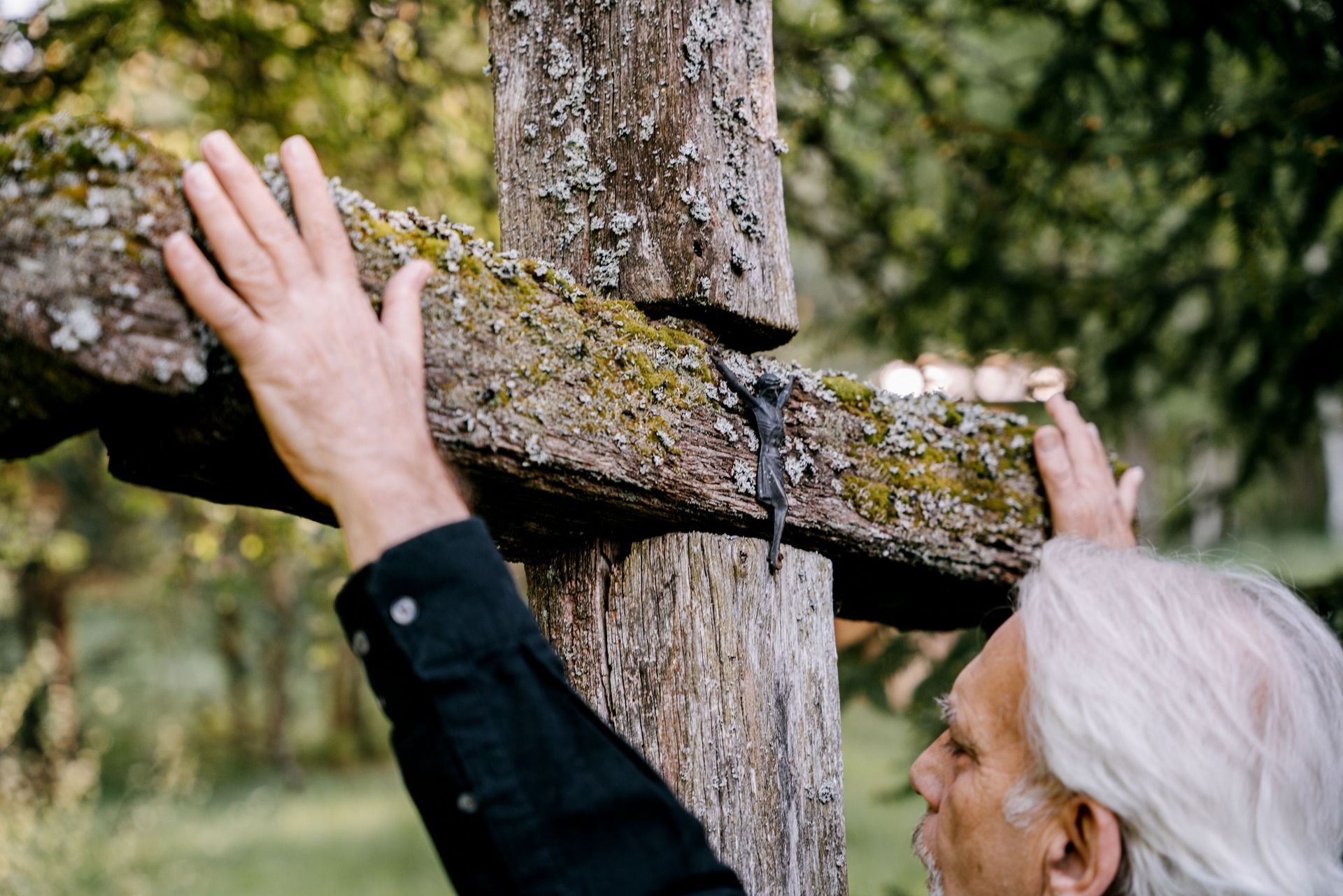
Jesus said, “If any want to become my followers, let them deny themselves and take up their cross and follow me.” The citizens of the Roman Empire were familiar with crosses. They were erected outside the cities of the Roman Empire for the execution of criminals and disobedient slaves. Crucifixion was the favored form of execution, because it was so excruciating and humiliating. The display of crosses made a point. The leaders of the empire were making sure everyone knew the terrible fate that awaited them if they disobeyed their masters or rebelled against the emperor. (I’m relying here on historian Tom Holland’s account in his 2019 book Dominion.) Crucifixion was not a topic that educated Romans liked to think about—which explains why, though this form of execution was widely used and accepted, there are few written accounts of it by writers of the ancient world. Among the accounts we have of crucifixion, four of them describe the execution of the same person. The victim was a wandering preacher from an obscure town north of Jerusalem; he was called Jesus of Nazareth. The four accounts of his crucifixion are found in the four Gospels. Those Gospel writers claimed that this crucified man was in truth God’s Son, and that after he was crucified, God raised him from the dead. No claim could have been more outrageous in the Roman world, or the Jewish world. People in the Roman Empire could easily imagine that great men like the emperor, Caesar Augustus, were divine. Caesar was often called a god or the Son of God. That made some sense because Caesar wielded godlike power over vast territory, and his career seemed a string of godlike triumphs. But that the son of God would be one of those unfortunate people humiliated and nailed to a cross—that seemed like a sick joke. As you came to church on this beautiful late summer day, I suspect that crucifixion was not what you were hoping to hear more about. And after all, we are a long way from Good Friday. But this little background helps us understand why Peter objects so strenuously when Jesus talks about taking up the cross. And when Jesus predicts that he will suffer and be killed in Jerusalem, it’s no wonder that Peter exclaims, “God forbid it! This must never happen to you.” He means: Not you, of all people. The messiah of God, crucified? God’s chosen one, crucified? What kind of sick joke is this? Peter was scandalized. And the scandal of the cross of Christ never quite goes away, no matter how many times we hear about it. But over the years, as Christians have pondered the passion of Christ, the meaning of the cross has seeped into people’s hearts and minds and created a new perception of how and where God may be at work. Even those who don’t think of themselves as Christians have been shaped by this Christian story. If God’s own Son was rejected and crucified, and then raised from the dead, then maybe the weak, the rejected, and the humiliated of the world are not despised by God, as was commonly thought. Maybe victims are innocent. Maybe they are people close to God’s heart. After the cross of Christ, we can never get it out of our heads that the powers of this world may get things terribly wrong. In God’s kingdom, Jesus said, the last will be first and the first will be last. And Jesus lives out this truth in his life. By his death and resurrection, Christ turns upside down our thinking about who are the winners and who are the losers. Jesus calls us to follow him in his upside-down life. He calls us to align ourselves with him and with all those who suffer rejection and humiliation. Jesus asks us to pick up a piece of his cross and bear some suffering or rejection for Jesus’ sake. Take up your cross, Jesus says. You don’t have to go looking for a cross to take up. Jesus himself does not go looking for a cross. But he accepted the cross when that was necessary to be faithful. You don’t have to go looking for a cross; the cross will find you—it will find you in the workplace, or in marriage, or in your family, or in your community. Or even at church. That story is at the heart of Claire Keegan’s recent book Small Things Like These. She tells the story of Bill Furlong, a man who delivers coal to his neighbors in a small town in Ireland. Bill is a hard worker, and he is devoted to his wife and five daughters. One of his regular customers is the local convent of Catholic sisters who run a program for unmarried mothers, most of them poor. The girls were seen as an embarrassment by their families and were quietly placed with the sisters. On his visits to the convent, Bill gets glimpses of how harshly these girls are treated; they are basically held prisoner, cut off from family and the outside world. Their babies are taken away from them—and where the babies are sent, the girls are never told. Thousands of Irish girls were in fact treated this way in a network of church-run programs known as the Magdalene Laundries. On one of Bill’s visits to the convent, he passes some girls scrubbing the floors. One girl grabs him and asks him to take her away. “At least take me as far as the river,” she says. “All I want to do is drown myself. Can’t you do even that much?” Bill moves past her, but he can’t get her words out of his mind. On his next delivery of coal to the convent, he opens the coal shed and discovers a young girl locked inside. She is barefoot and shivering from the December cold. He gives her his jacket and leads her to the convent and knocks on the door. They are greeted by the Mother Superior, who ushers Bill and the shivering girl inside and serves them tea. The Mother Superior acts kindly, but she shrewdly pressures the girl to say she must have been accidentally left behind in the coal shed after a game of hide-and-seek. Bill doesn’t buy that explanation, but he says nothing. As Bill prepares to leave, the Mother Superior hands him an envelope. It’s a generous Christmas bonus. Bill knows it is meant to ensure his silence about what he has seen. While he goes about his day, Bill can’t stop thinking about what is going in the convent. Bill’s wife and others in town tell him to mind his own business. Nothing good can come from opposing the convent, they tell him. The sisters have a lot of power, and they are backed by the forces of the church and the state and public opinion. Bill’s wife and friends remind him that the nuns can deny his daughters a place in the local Catholic school if he gets on their wrong side. But Bill is nagged by a question: What if those were his daughters? “Was there any point in being alive [he wonders] without helping one another? Was it possible to carry through all the years . . . without once being brave enough to go against [the powers of the world] and yet call yourself a Christian?” That evening he goes to the convent, opens the door of the coal shed, and discovers that the same girl has again been locked inside, barefoot and thinly dressed against the cold. He puts his coat around her and leads her outside, and this time they walk toward Bill’s home. He intends to make her part of his family, though he knows it won’t be easy. His wife and his neighbors won’t be happy about this. He knew the worst was ahead of him. But in another way the worst was behind him—for how much worse it would have been for him to have done nothing, and to have gained the world but lost his soul. As Bill walks with the girl toward home, Keegan writes, he felt a kind of lightness; he felt an “unrecognizable joy” and peace. He felt like the best part of himself was emerging. Jesus says that by giving our live away for the sake of the gospel we will find our lives. The cross of Christ is God’s gift to us, so that we can find in this troubled world a different kind of peace than the world gives. God promises to meet us at the crosses that find us, and to fill our lives with his presence—with grace and peace, and an unrecognizable joy. Today God is sending us the Holy Spirit to bring out the best part of ourselves, through Christ our Lord. Pentecost 14A August 30, 2026 Ascension Lutheran Church Matthew 16:21–28

I saw Christopher Nolan’s film version of The Odyssey— it’s three hours long, but the time goes by quickly! If you’ve never read Homer’s epic poem (as I hadn’t), the movie conveys some of the scope and power of this great story.. Matt Damon plays the main character, Odysseus, as a soulful warrior. As the story unfolds, Odysseus mourns the countless deaths he has caused in battle and regrets the duplicity of his famous military trick—hiding soldiers inside a wooden horse in order to defeat the Trojans and destroy the city of Troy. An ingenious and brave leader, Damon’s Odysseus also broods over the “law of Zeus,” which commands respect for all human beings, something Odysseus knows he has failed to do. As several commentators have pointed out, this version of Odysseus departs from Homer and the classical traditions of Greece and edges toward a Biblical vision. Nolan, the director, might well have felt he needed to make this revision so that modern viewers could identify with Odysseus. The ancient world would have had few of the scruples expressed by Odysseus in the film. Ancient Greek and Roman societies celebrated the warrior virtues—strength, valor, honor, and the glory of military triumph. They assumed that the strong dominate the weak, and that the weak serve the strong. As one ancient historian put it, “The strong do what they can and the weak suffer what they must.” That’s just how the world works. Leaders of the ancient world would have agreed with the presidential adviser who recently explained US policy to a CNN reporter: “We live in a world . . . that is governed by strength, that is governed by force, that is governed by power. These are the iron laws of the world since the beginning of time.” It took a revolution in morality for an alternative worldview to emerge. Living on the other side of that revolution, we tend to assume that the exercise of power must be judged by moral norms of justice. We seek to listen to the voice of victims and we regard compassion for those who suffer as the essence of morality. To the extent we share those views, it is because we are shaped by centuries of Christians preaching, teaching, and meditating on the Gospel stories, which turned the world upside down with teachings like “Love your enemies” and “The last will be first and the first will be last.” The beginnings of this revolution can be traced to this week’s Gospel reading, in which Jesus discloses that he, the very Son of God, will become one of the least in the world. He “must go to Jerusalem and undergo great suffering at the hands of the elders and chief priests and scribes and be killed and on the third day be raised.” God’s Son will himself become a victim of those in power before he is raised in glory. This was an outrageous idea to the ancient mind. The belief that the Son of God suffered for the truth, and that those in power can be massively wrong, has transformed the way the world thinks about what power is for, and whose side God might be on. See you in church, Pastor David